

Collaboration models
for every context.

Context analysis.

Budget definition.

Scope definition.
Activities, responsibilities, and boundaries are clarified to reduce ambiguity, shifting requirements, and operational friction.

Model selection.
The most suitable collaboration model is identified according to the context, balancing flexibility, control, and the level of uncertainty.
Collaboration models
for every context.
Context analysis.
Constraints, objectives, and operational challenges are gathered to understand the project before making decisions.
Budget definition.
A coherent investment framework is defined, avoiding unrealistic expectations and unnecessary waste of resources.
Scope definition.
Activities, responsibilities, and boundaries are clarified to reduce ambiguity, shifting requirements, and operational friction.
Model selection.
The most suitable collaboration model is identified according to the context, balancing flexibility, control, and the level of uncertainty.
Risk Reduction Project (RRP)
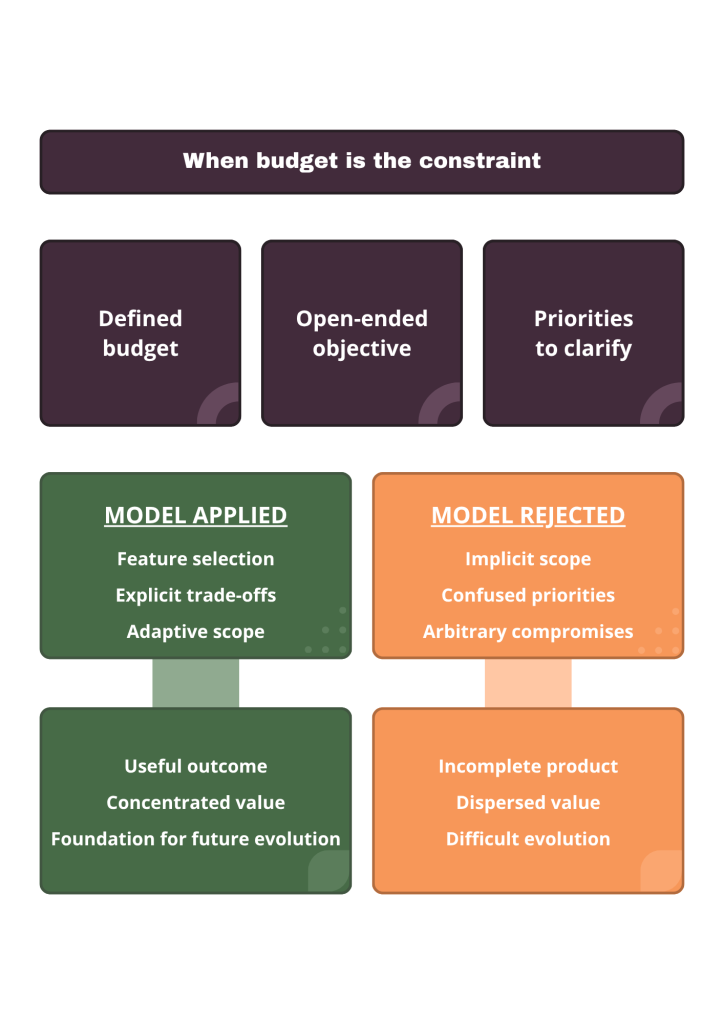
There are situations where the budget is fixed, timelines are tight, and the objective cannot be fully defined from the beginning.
This often happens with MVPs, functional prototypes, product exploration initiatives, performance interventions, or technical debt reduction efforts. In these contexts, promising a fixed list of features usually leads to fragile decisions.
Fixed-budget prototyping is designed to maximize value within clear constraints. It means deciding what to build, what to simplify, and what to exclude, focusing effort on the elements that allow teams to learn, validate assumptions, or unlock the next step.
This approach requires seniority: most of the value comes from the quality of the decisions being made. The outcome is a self-consistent deliverable — something functional enough to stand on its own and support better decisions moving forward. It enables the budget to be used intentionally, avoiding investment in refining the wrong direction
Use this model when budget and timelines are fixed, but defining everything upfront is either impossible or unnecessary. It is ideal for MVPs, prototypes, and exploratory initiatives where the goal is to maximize value and quickly understand what actually works.
Avoid this model if you expect completeness or full feature coverage. If the requirement is to “build everything,” this approach will not hold: it requires choices and accepted trade-offs. If you are not willing to cut scope, you are using the wrong model.
Defined Outcome Project (DOP)
Not every project should begin with development.
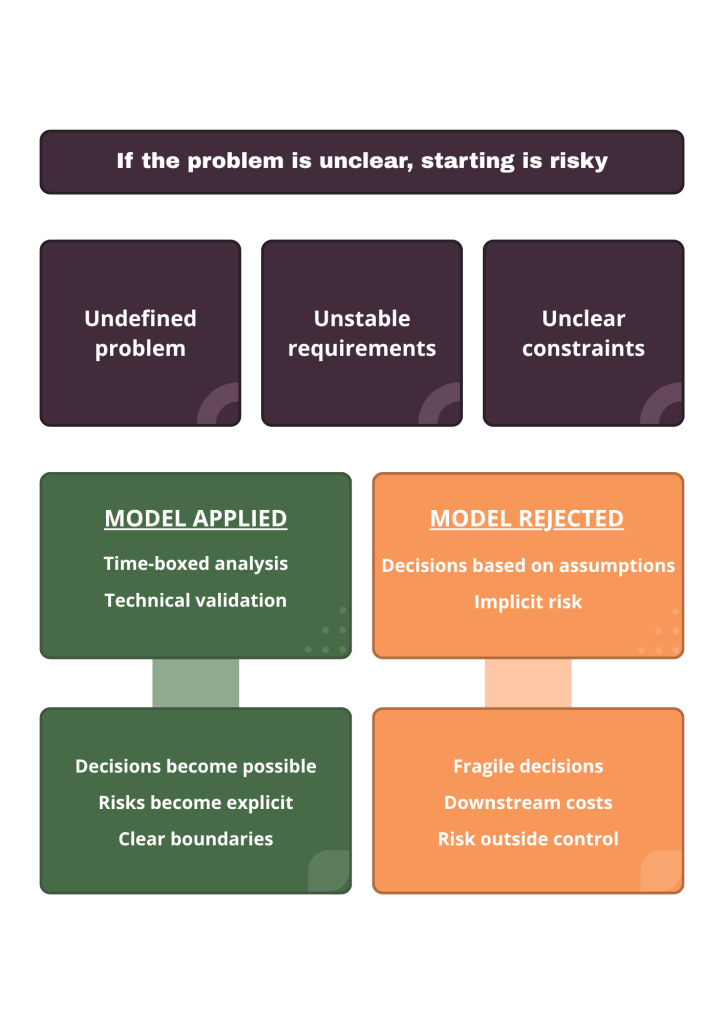
When the problem is poorly defined, requirements keep changing, or technical and organizational constraints are unclear, starting to write code immediately simply pushes risk further down the line — where it becomes far more expensive. In these situations, the first step is reducing uncertainty.
Risk reduction is a focused, time-boxed intervention designed to clarify the elements that matter for deciding how to proceed. It may involve architecture definition, integration contracts (such as endpoint and payload format specifications), mockups, technical feasibility assessments, alignment between goals and budget, or organizational issues that impact the software. The objective is to reduce ambiguity enough to make informed decisions.
The outcome is operational clarity: a map of risks, clearer boundaries, concrete options, and a stronger basis for deciding whether to move forward, change direction, or stop entirely. This approach is particularly suited to high-uncertainty contexts.
Use this model when the problem is still unclear, requirements keep changing, or there are too many uncontrolled variables. It is the right approach when making the wrong decision early on could become far more costly later. Its purpose is to understand whether to move forward — and how to do it.
Avoid this model when objectives, scope, and constraints are already clear and shared by all stakeholders. In these cases, additional analysis only slows execution and introduces unnecessary overhead. If you already know what needs to be built, you do not need risk reduction — you need delivery.
Value-Constrained Project (VCP)
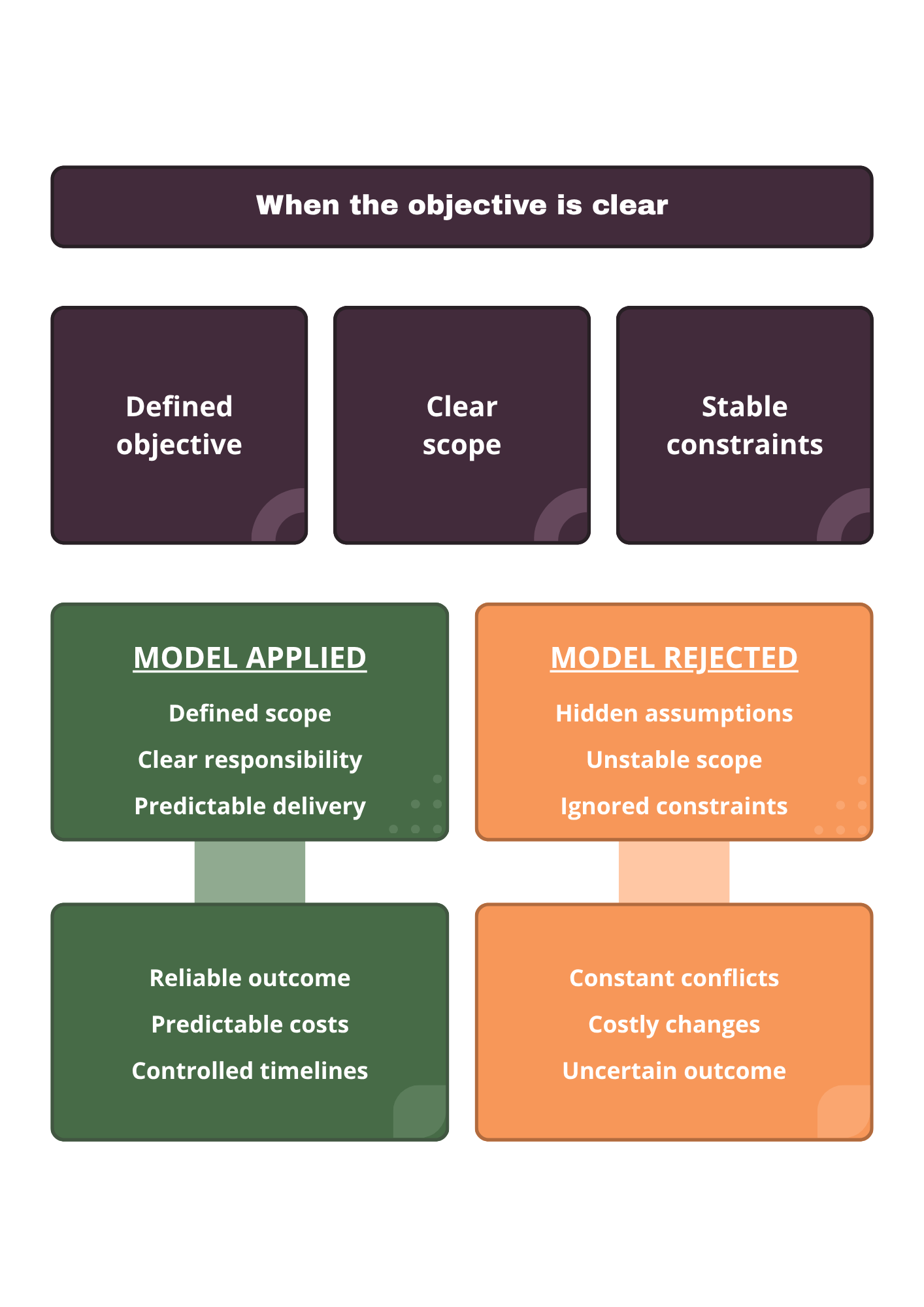
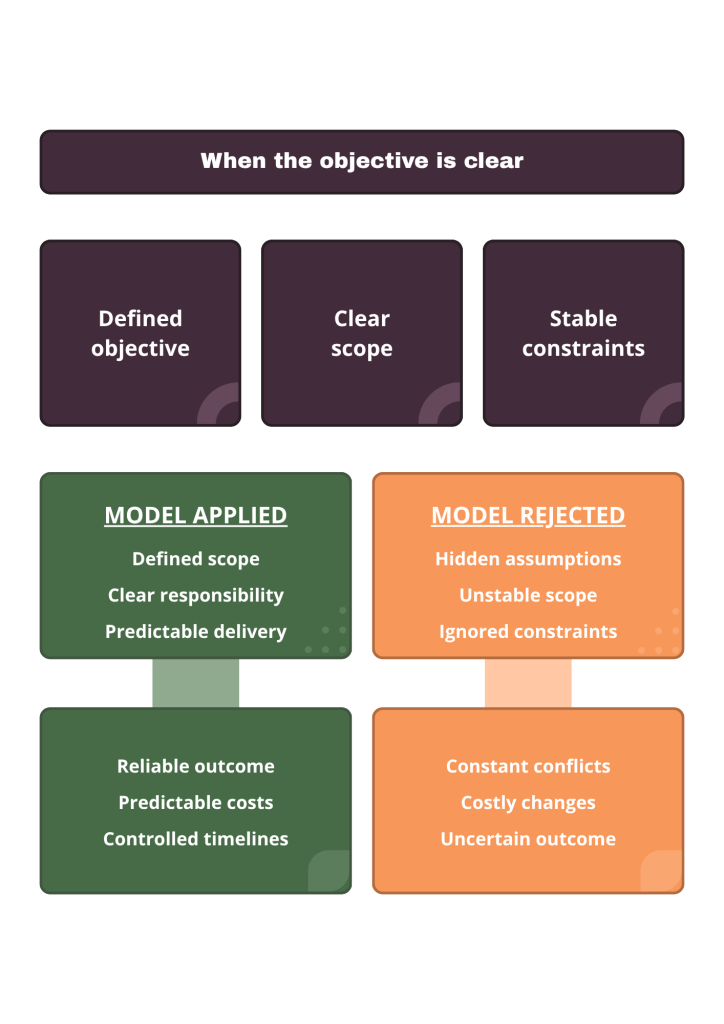
This model works when the objective is well defined, the scope is clear, and timelines, budget, and responsibilities are shared realistically across all stakeholders.
Clarity is also required around alternative scenarios, error handling, acceptance criteria, and expected outcomes. In a clearly defined project, the commitment is tied to the result. We make explicit what needs to be delivered: detailed mockups, API contracts, application flows, exception management, dependencies, and delivery conditions.
The goal is to eliminate ambiguity where ambiguity should no longer exist. The project should still be developed iteratively, limiting implementation to the areas that have already been clearly defined.
Use this model when you know exactly what you want to achieve, the expected outcome has been defined in a verifiable way, and you are ready to commit to timelines and budget. It is the right approach when uncertainty is low and the focus is on execution, not exploration.
Avoid this model when requirements are still vague, frequently changing, or affected by hidden ambiguities. In these situations, forcing a fixed-outcome project creates unrealistic expectations and unnecessary conflict: the model may appear solid, but it rests on unstable foundations.
Capacity Engagement (CE)
A structured project is not always necessary.
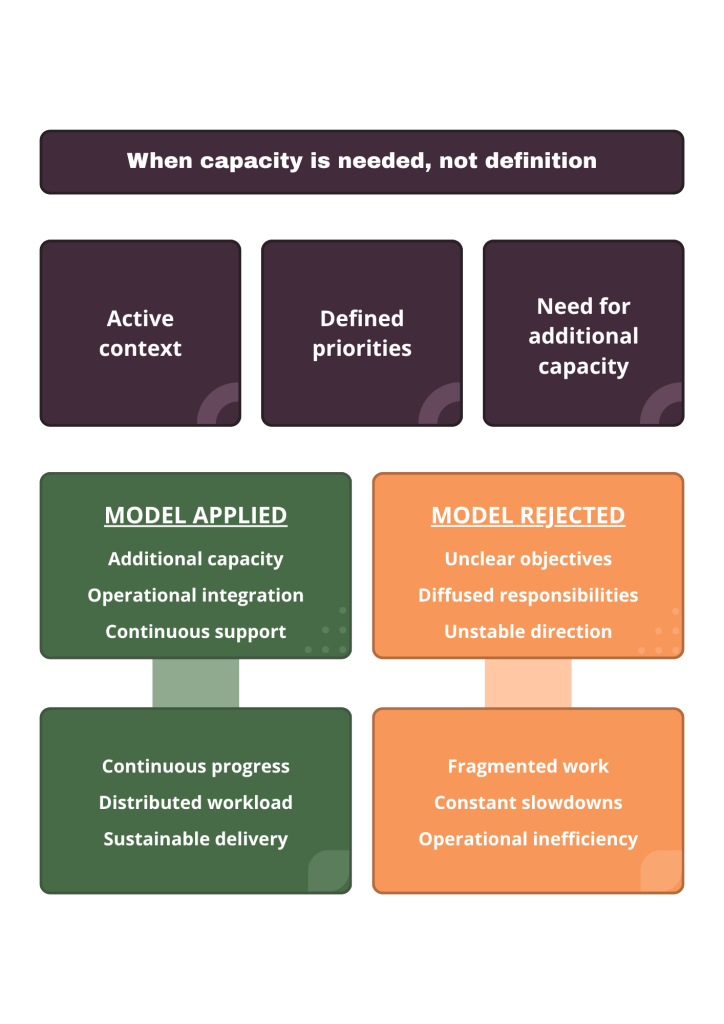
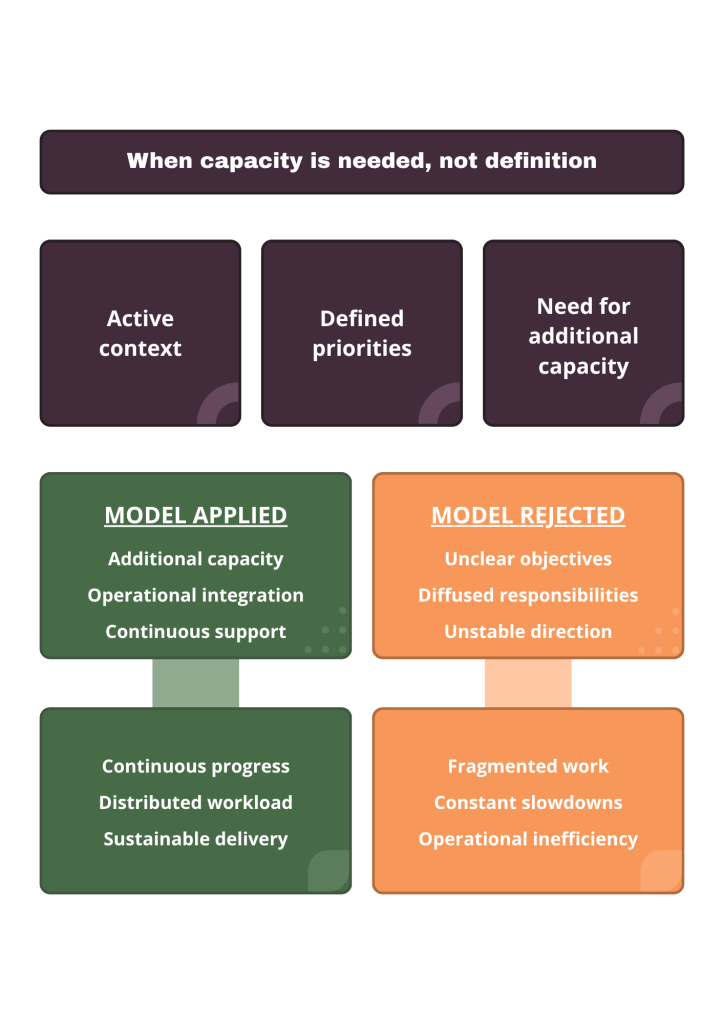
Sometimes the real issue is capacity: overloaded teams, disorganized environments, slow decision-making, or the need for experienced professionals to stabilize a critical situation. In these cases, what is needed is the integration of expertise.
This is a capacity-based engagement managed intentionally. We provide senior developers, architects, or coordination roles for a defined period, with the goal of increasing team capacity, clarifying constraints, reducing operational chaos, and preparing the ground for a more structured phase. The right expertise is introduced where and when it is needed most.
This approach is particularly effective in ongoing or mature environments, as well as in temporarily blocked situations. Its value lies in making decisions faster, clearer, and more traceable, while creating a more sustainable operational context over time.
Use this model when the main issue is not the project itself, but capacity: the team is under pressure, the context is disorganized, or experienced guidance is needed to support better decision-making. It is useful for stabilizing operations, accelerating progress, and preparing the ground for what comes next.
Avoid this model if you expect the provider to take full responsibility for the outcome. In this approach, most of the risk remains on your side: it is a model designed to extend capabilities, not to guarantee results. If you are looking for a commitment tied to the outcome, a different model is needed.
Our process

Initial alignment call
We focus on the real problem, not the assumed solution.

Context clarification
We analyze technical, organizational, and business constraints.

Informed decision-making
We provide the elements needed to decide whether and how to proceed.

Project model selection
Selection of the most appropriate collaboration model.
Ready to discuss your project
with a technical approach?
with an engineer.
Call di orientamento
Mettiamo a fuoco il problema reale, non la soluzione ipotizzata.
Chiarimento del contesto
Analizziamo vincoli tecnici, organizzativi e di business.
Decisione consapevole
Forniamo gli elementi per decidere se e come procedere, insieme.
Selezione del progetto
Adozione del modello di collaborazione adatto e comunicazione costante.
Pronti a discutere il vostro progetto
con un approccio tecnico?
con un ingegnere
Our process
Initial alignment call
We focus on the real problem, not the assumed solution.
Context clarification
We analyze technical, organizational, and business constraints.
Informed decision-making
We provide the elements needed to decide whether and how to proceed.
Project model selection
Selection of the most appropriate collaboration model.
Ready to discuss your project
with a technical approach?
with an engineer.
Initial alignment call
We focus on the real problem, not the assumed solution.
Context clarification
We analyze technical, organizational, and business constraints.
Informed decision-making
We provide the elements needed to decide whether and how to proceed.
Project model selection
Selection of the most appropriate collaboration model.
Ready to discuss your project
with a technical approach?
with an engineer.